The Russian Snow
My darling Natasha,
The snow is falling again. Here, in the foothills of the Carpathians, June brings not summer but a strange white silence that settles over the trenches like a shroud. The men huddle in their greatcoats and speak of home. I sit in my corner of the dugout, a candle burning low, and I think of our orchard — the cherry trees you loved, how they blazed white every spring, how the petals would drift across the table where we took our tea. I can almost taste the jam you used to make, the one your mother taught you. It is absurd, what a man remembers when he may be about to die.
This morning the guns fell quiet for an hour, and in that stillness I heard a bird singing. It was a small thing, a finch perhaps, and it perched on the edge of a shell crater and sang as though the world were not on fire. I thought of Turgenev, of the lines he wrote about the Russian countryside — how even in the midst of suffering, there is a terrible, stubborn beauty that will not be silenced. I have carried a volume of his stories in my pack since I left home. The pages are soft with damp now, and I have read them so often that I know whole passages by heart. When I close my eyes, I hear his voice, and through it, the voice of Russia itself, ancient and enduring.
I cannot tell you what we are doing here, Natasha. I cannot give you a grand purpose for this war. I have seen the villages we have passed through — burned, abandoned, their inhabitants fled into the forests. I have seen the faces of the men I command, boys mostly, who look at me with eyes that have aged a century in a year. I try to speak to them of duty and of God, but the words feel hollow. What I feel instead is a vast, crushing sadness — for them, for us, for the world that will emerge from this slaughter. I think perhaps the only truth I still hold is you. You are the fixed point in a universe that has spun off its axis.
Do you remember the afternoon we lay in the grass beneath the largest cherry tree? You had your head on my chest, and I read to you from Pushkin, and you fell asleep in the warm sun. I watched your breathing, the rise and fall of your shoulders, and I thought: this is happiness. This is what the poets mean, what the philosophers spend their lives chasing. It was not passion or triumph or achievement. It was simply lying in a field with the woman I loved, a book open on my chest, and nowhere in the world to be. I have held that afternoon like a jewel through every dark hour of this war.
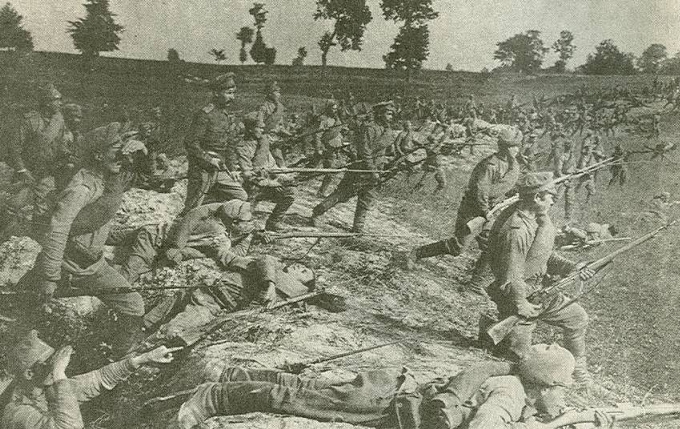
The orders have come. We are to advance at dawn. The Austrians are dug in across the valley, and the artillery has been pounding their lines for three days, but I know — I know — what awaits us. I have read the dispatches. I have seen the casualty lists. I am not a naive man, Natasha. I am a soldier, and I have learned to look at death the way a farmer looks at weather. I am not afraid for myself. I am afraid for you — for the life we will not have, for the children we will not raise, for the cherry blossoms we will not see again together.
If this letter reaches you without me, know that I removed my wedding ring and placed it inside the envelope. It is the only thing of value I possess. I want you to have it. I want you to wear it or sell it or hold it in your palm when the world feels too heavy. It is not much — a band of gold — but it has been next to my heart for nearly two years, and it carries all the love I could not fit into words.
I hear the priests beginning the liturgy. The men are crossing themselves. I should join them.
Forgive me. For everything. For leaving you. For the sleepless nights. For the life we will not share. And thank you — for the cherry blossoms, for the poetry, for the afternoon in the grass, for every moment you were mine.
If there is a God, He will let me see you again. If there is not, then I have had enough heaven in your arms to last an eternity.
Your Dmitri
What Happened
Aftermath
Historical Context
Timeline
Germany declares war on Russia. Dmitri, a university-educated landowner from Tver, is commissioned as an officer in the Imperial Russian Army.
Dmitri marries Natasha in a small Orthodox ceremony. They have three weeks together before he is deployed to Galicia.
Dmitri writes Natasha from the Carpathian front. He describes the snow and says he dreams of their orchard every night.
The Brusilov Offensive begins. Dmitri writes this letter at dawn, knowing his regiment will assault the Austro-Hungarian lines at Lutsk.
Dmitri is killed by shellfire at his command post. His orderly retrieves the letter and his wedding ring.
The Bolshevik Revolution. Natasha flees Petrograd carrying only the letter and the ring.
Natasha arrives in Paris. She begins a new life as a seamstress.
Natasha dies in Paris at 84. The letter and ring are donated to the Russian Émigré Archive.
Origin
More from World War I
My Darling Zen
Frederick Key wrote 42 letters and 15 postcards to his beloved Zen Hall. This was his last — written on Valentine's Day 1916. He died on the first day of the Somme. She wrote in her diary: 'Letter came saying my darling killed... went to Lichfield.'
Frederick Key → Zen Hall
I Never Got to Say Goodbye
Henri wrote to his wife Marie from the hell of Verdun, describing a daughter he had never seen. The letter fell from his pocket as he died. A German soldier kept it for ninety years before it was returned to Henri's granddaughter.
Henri Dubois → Marie Dubois
The Boy Who Died on His Wedding Day
Thomas married his childhood sweetheart Emily at 8 AM on July 1, 1916. By noon he was on the front. By 4 PM he was dead. His letter was found in his breast pocket, still smelling of her perfume from the ceremony.
Thomas Fletcher → Emily Fletcher