The Nurse from Étaples
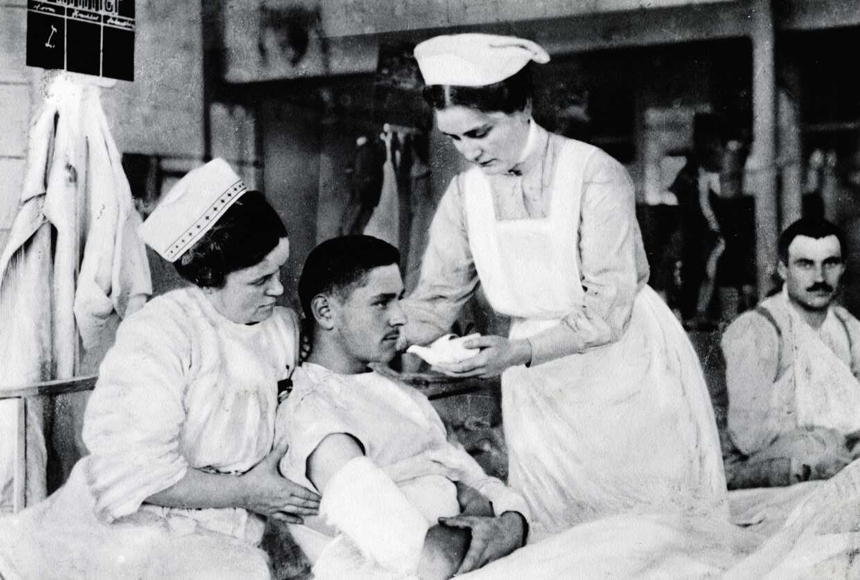
My dearest Molly,
I am writing this by the light of a candle that keeps flickering out, somewhere in a barn that smells of hay and damp wool, with the sound of guns rumbling in the distance like thunder that never stops. The lads are asleep around me — Bill, who talks about his mum’s meat pies; Tommy, who carries a photo of a girl he met in London; old Sergeant Green, who has been fighting since 1914 and still believes we will be home by Christmas. They are good men. They are brave men. But none of them know what I know — that the bravest person I ever met was a Scottish nurse with red hair who held my hand while a surgeon cut the shrapnel out of my shoulder.
Do you remember that day, Molly? I was terrified. I had been shot before — a graze, nothing serious — but this was different. The bone was exposed. The blood would not stop. They brought me into that white room with the bright lights, and I could smell the antiseptic and the ether, and I thought: this is it. This is how I die, on a table in a foreign country, far from the gum trees and the dusty roads I grew up on. And then you were there. You took my hand. You said, “It’s all right, soldier. I’ve got you.” And I believed you. In that moment, with the pain screaming through my body and the surgeon’s saw already in his hand, I believed you. I let go of everything — the fear, the fight, the hope — and I trusted you.
You held my hand through the whole thing. Do you know that? Maybe you do it for every man, maybe it is just what nurses do. But for me, for Jack Gallagher from a nowhere town in New South Wales, it was everything. When I woke up in the ward, groggy and sick, the first thing I saw was your face. You were checking my bandages, your brow furrowed with concentration. I wanted to say something, to thank you, but all that came out was a croak. You smiled. You said, “Welcome back, soldier.” And I thought: I never want to leave.
I did leave, of course. They always make us leave. But I have carried you with me the way a man carries water through a desert. Every time I have been cold or scared or tired, I have thought of your hand in mine. It has saved me more times than you will ever know.
Molly, I am not a poet. I am a stockman who can ride a horse and shoot a rifle and little else. I do not know the right words to tell a woman that she has changed the course of my life. But I know this: before I met you, I was drifting. I enlisted because my mates did, because it seemed like an adventure, because I was young and stupid and did not know what I was worth. You showed me what I was worth. You held my hand and you made me feel like I mattered.
I am going into battle soon. They say it will be a big one — mines, artillery, the whole business. I am not going to lie to you: I am scared. Every man who tells you he is not scared is either a fool or a liar. But I am less scared because of you. Because I know that somewhere in the world, there is a woman with red hair and steady hands who once told me it would be all right. And if a man can be loved by such a woman, then his life has been worth something, no matter how short.
Wait for me, Molly. I’ve survived this long. I’ll survive for you.
If I don’t make it, know that you were the last beautiful thing I saw in this world. That white ward in Étaples — that was not a hospital. That was heaven, and you were its angel.
Yours always, Jack
P.S. — I’ve enclosed a photograph of me taken in Sydney before I shipped out. It’s not much — I look like a larrikin who’s never done a day’s work in his life. But it’s the only one I have. Keep it. And if you ever find yourself in Australia, look up at the stars. They’re brighter than anywhere else. I’ll be watching them with you.
What Happened
Aftermath
Historical Context
Timeline
Jack Gallagher enlists in the Australian Imperial Force in Sydney. He is a stockman from rural New South Wales.
Jack is wounded in the shoulder by shrapnel during the Battle of Fromelles, one of the worst days in Australian military history.
Jack arrives at the Étaples hospital complex. He is assigned to the ward where Molly Sinclair works.
Jack is discharged from hospital and returned to his unit. He and Molly have exchanged letters for three months.
Jack writes this letter from the front lines near Messines. He promises to come back.
Jack is killed during the Battle of Messines Ridge. His letter is found in his pocket and posted to Molly.
Molly receives the letter. She reads it in the linen cupboard of the hospital where they met.
Molly dies in Edinburgh at 79. The letter is found in her nurse's uniform pocket, preserved since 1917.
Origin
More from World War I
Cups of Tea and Gentle Hands
Edith, a VAD nurse at the vast Étaples base hospital, writes to her sister Margaret in London as the wounded from the Somme pour in like a tide. She describes the horror, the humour, and the small graces that keep her going.
Edith Baker → Margaret Baker
The D-Day Wife
On June 6, 1944, Audrey Gerrans stood on Snips Hill waving a white handkerchief as her husband's convoy rolled past in the dark. She didn't know if he saw her. She wrote him this letter anyway.
Audrey Gerrans → Joe Gerrans
The Christmas Truce Letter
A German theology student writes to a woman he has never met — falling in love with her photograph during the Christmas Truce of 1914. The letter was found in his kit after he was killed.
Klaus Weber → Alice